Category: Question of the day

No, Windows Phone ActiveSync is not on par with OWA for Devices

Recently I came across this Twitter exchange: @WayneHRiddle You don’t need it for WP. Native app handles all of that functionality. — Ben Rudolph (@BenThePCGuy) January 17, 2015 I’ve heard this argument before, that the Exchange ActiveSync (EAS) implementation in Windows Phone doesn’t require an OWA for Devices app (or MOWA as is the official acronym) like iOS has (for iPad...

Do not update your Office Web Apps Server with automatic updates

Although it is not exactly required to deploy with Exchange Server 2013, Office Web Apps Server (OWAS or also referred to as WAC server) provides a more user friendly experience instead of the standard Web Preview. For Lync Server 2013 it’s a requirement if you want to be able to present PowerPoint files in a conference. And well, for SharePoint...

Managing Mailbox quota’s: databases with different settings?

So, a while back I discussed an on-premises Exchange design for a customer. When discussing database distribution in an Exchange 2013 Database Availability Group (DAG), the topic of mailbox quota’s came along. They insisted on having different Database (DB) level quota’s and move mailboxes to other databases when the user requires more storage space. It’s a tactic I have seen...

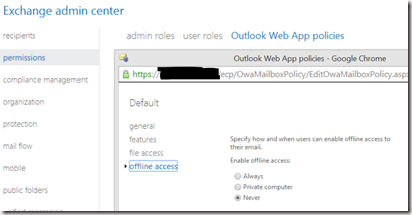
Disable Offline OWA in Exchange 2013

Although the Offline OWA functionality in Exchange 2013 is a great addition for those that cannot use Outlook (Anywhere with Cached Mode), but are frequently without internet. However, as the browser database in which Exchange OWA stores it’s information isn’t encrypted, it can be a security issue. It can be turned of via the Exchange Admin Center (EAC) via Permissions>Outlook...

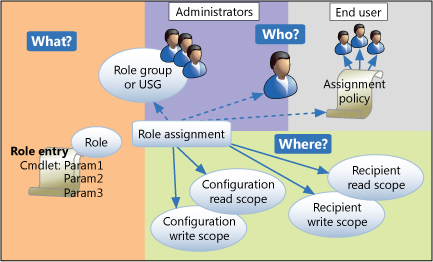
Exchange RBAC might be more granular than you think

Most Exchange admins probably know (or should know )  the permission model since Exchange 2010 is Role Based Access Control, RBAC for short. With it, you can regulate quite granularly what admins and end-user are able to do, without the hassles of Access Control Lists (ACLs). However, it recently became clear that it might be more granular than you think....

Failed Exchange Server 2013 CU2 & CU3 install due to security update 2874216 (updated again)

Today a customer asked for my help because an installation of Exchange Server 2013 Cumulative Update 2  (v2) had failed; Their Exchange environment didn’t work anymore and they were stuck. During the installation from Cumulative Update 1 (CU1) to Cumulative Update 2 (CU2), they encountered the following error: Error: Unable to remove product with code 4934d1ea-be46-48b1-8847-f1af20e892c1. Fatal error during installation....

Apple iPhone 5s TouchID and Exchange ActiveSync (updated)

2013/10/17: Added support statement by Microsoft below Just today I was curious how the Apple biometric convenience solution TouchID on the iPhone 5s would impact password policies enforced by Exchange ActiveSync(EAS). I frequently run into complaints from Android users who previously used a Pattern Lock instead of a PIN to unlock their phones. When my EAS policy sets specific password...

My portable lab hardware

Recently somebody asked via Twitter my what the make and model is of my laptop, used for Exchange testing environments. Well, 140 characters is not a lot of space so I decided to blog about it. Our company uses Dell laptops as a laptop standard, but other vendors might have comparable configurations. The main model type is a Precision M4700,...

Book Review: iPhone with Exchange Server 2010 – Business Integration and Deployment by @stevegoodman

Recently Steve Goodman released his “iPhone with Exchange Server 2010 – Business Integration and Deployment” book by Packt Publishing. The first half of the book is a compact description of basic Exchange 2010 knowledge and the  necessary configuration for iOS connectivity (even with Office 365) via Exchange ActiveSync. After that more specifics topics regarding policies, Certificate based Authentication and some...

Exchange 2010 calendar publishing URLs are not updated after migrating to Office 365

With Exchange 2010 Service Pack 1 it became possible to share your calendar with anyone outside of you organization, depending on the Sharing Policy implemented by your Exchange Administrator. Users can then share their calendar via an obfuscated or an relatively public URL without the need for authentication (and SSL for that matter). For more information on how to prepare...

Transporter Suite issues while migrating from generic IMAP to Exchange 2007

Yesterday we encountered an issue during the last sync from an generic IMAP server to an Exchange Server 2007 SP3 server on Windows Server 2008 R2 (there were reasons not to migrate to Exchange 2010 that are beyond the scope of this post ). We used the Microsoft Transporter Suite. Although the initial big bulk sync was performed without a...

Send As permission on Office 365 not with Add-ADPermission

With an On-Premises Exchange 2010 environment an administrator hands out Send-As permission with the Add-ADPermission cmdlet. But I found out that this doesn’t work in Office 365. In this case a P plan (no Dirsync, Federation or such), you can see the result in the screenshot: Funny thing is that if you try Add-MailboxPermission to add Send-As permission, the error...