Category: Exchange 2007

The end is nigh for Exchange 2007: support nearing end and some other reasons to upgrade

The Exchange Team blog reminded us today that in about a year the extended support for Exchange Server 2007 will end. This means no more updates of any kind, not even security updates. Feature updates already stopped 4 years earlier when Mainstream support ended. The product will continue to run, but how longer it’s being kept in production that will...

Exchange 2013 CU7, Exchange 2010 SP3 RU8 and Exchange 2007 SP3 RU15 are out!

Update 12 december 2014: The fixed Exchange 2010 SP3 RU8 with v2 is now available. Same location as the plagued v1. Update 10 december 2014: Exchange Server 2010 SP3 RU8 has been pulled due to connectivity issues with Outlook. There is currently not ETA on the fix. Customers are advised to not install this RU8 or remove RU8 if they...

Released: Exchange 2013 CU6, Exchange 2010 SP3 RU7 and Exchange 2007 SP3 RU14

Today Microsoft released the 6th update to Exchange Server 2013, aptly named Cumulative Update 6 (CU6), the seventh update to Exchange Server 2010 SP3; Rollup Update 7 (RU7) and the 14th update to Exchange Server 2007 SP3 named Rollup Update 14 (RU14). They mostly contain smaller security fixes and/or bug fixes or DST (Daylight Saving Time) updates. Having said that,...

Be careful with Outlook customizations! Use AutoDiscover!

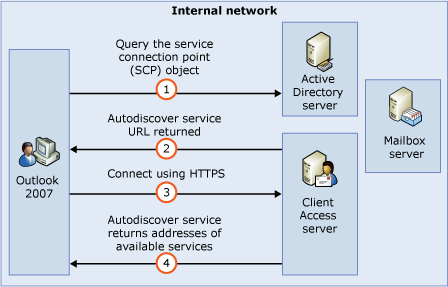
During a migration from Exchange 2007 to 2013, we moved several mailboxes as pilot users. Coexistence was fully configured and on my test machine everything worked fine. However, the pilot users had trouble connecting with Exchange 2013 after their mailbox was successfully moved to Exchange 2013 servers. OWA and ActiveSync worked without any hitch. The problem was that Outlook would...

The UC Architects Episode 35: Service Packed! is available now!

A few days ago episode 35 of The UC Architects podcast went live! Service Packed! With Steve Goodman hosting, joined by John Cook, Michael Van Hybrid, Michel de Rooij, Serkan Varoglu, Ståle Hansen and yours truly. Our editor was the legendary Andrew Price. In this episode we talk (a lot) about Exchange Server 2013 Service Pack 1, a quick review...

I will be presenting at the NGN Exchange evening event on 25th November

On the 25th of November the Dutch usergroup NGN (Netwerk Gebruikersgroep Nederland) will organize an Exchange themed evening event and I’m one of the speakers. I’m extra excited as it will be held at the OGD ICT Diensten head office in Delft, my employer! My session will be about Exchange and mobile devices, focused on ActiveSync but also on Outlook...

My portable lab hardware

Recently somebody asked via Twitter my what the make and model is of my laptop, used for Exchange testing environments. Well, 140 characters is not a lot of space so I decided to blog about it. Our company uses Dell laptops as a laptop standard, but other vendors might have comparable configurations. The main model type is a Precision M4700,...

Transporter Suite issues while migrating from generic IMAP to Exchange 2007

Yesterday we encountered an issue during the last sync from an generic IMAP server to an Exchange Server 2007 SP3 server on Windows Server 2008 R2 (there were reasons not to migrate to Exchange 2010 that are beyond the scope of this post ). We used the Microsoft Transporter Suite. Although the initial big bulk sync was performed without a...

Setting the Postmaster address in Exchange

Somebody asked me today, whether it is a good idea to set the postmaster address in Exchange. Well, short answer: yes! It’s is even mandatory according to RFC 5321 section 4.5.1. For Exchange 2010 you will have to use the Set-TransportConfig cmdlet: Set-TransportConfig -ExternalPostmasterAddress <ExternalPostmasterSMTPAddress> For Exchange 2007 you will have to use the Set-TransportServer cmdlet for each Hub and...

Can you easily restrict or accept messages to a Distribution Group?

Today’s question of the day is whether you can restrict users mailing to a specific Distribution Group in Exchange? Yes, you can. You can add users but also Distribution Groups to the list of who the Distribution List will accept messages from. The messages of members of the Distribution will then be accepted. A (mail enabled) Security Group is also...